On Pleasureful Pastry

Chef Linda's Confection Commentary

Euclidian Geometry = Chocolate + Strawberries + Bananas

Flavors easing into one another, gently releasing their separation…

In mathematics, the first of Euclid’s five general axioms is: “Things which are equal to the same thing are equal to each other.” IMAG1827Chocolate and strawberries and chocolate and bananas and, heaven knows, strawberries and bananas have affinity relationships with one another. So, in a somewhat Euclidian way I hoped that there was a flavor triad among the three.
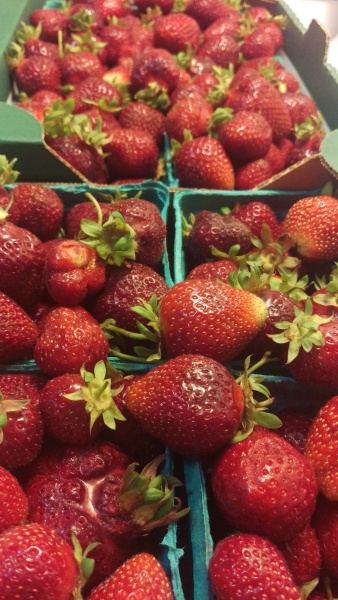
The strategy also centered around quickly ripening bananas and my personal commitment to minimize waste to every extent possible when I cook for myself and as pastry chef at Nicoletta’s Table. Restaurants have a great responsibility to reduce waste.  For inspiration, I began with a banana bread recipe from Massimo Bottura‘s book, Bread is Gold.

The second goal was to create the greatest intensity of flavor. I’m a huge proponent of roasting, smoking and dehydrating fruit to maximize flavor. Using techniques that enhance the singularity of individual flavors is a core practice. Throughout last season’s fruit harvest, I slow-roasted local fruit for Roasted Balsamic Strawberry Jam, Rustic Apricot Jam, Dark Sweet Cherry Compote and Elberta Peach Jam.

Euclid’s 5th general axiom is, “The whole is greater than the part.” Reading and researching flavor affinities is an important tool in professional cooking. Confident creativity arises from research and experimentation. And, it’s fun.

Roasting bananas removes some of the moisture present in the fruit, intensifying flavor and allowing an increase in the quantity of bananas from 3 to 5. Using brown, clarified butter and brown sugar also benefit the overall flavor profile.

BROWN BUTTER BANANA BREAD

1 3/4 C (8 3/4 oz) all-purpose (AP) flour

1 tsp baking soda

1/2 tsp kosher salt

5 very ripe bananas, peeled

8 T ( 4 oz) brown clarified butter

2 large eggs

3/4 C packed (5 1/4 oz) light brown sugar

1 tsp vanilla extract (VE)

Preheat oven to 350 degrees F. Slice peeled bananas; place on parchment-paper lined sheet pan. Roast for 15 min or until soft and liquid separates from the bananas; strain the liquid. Cool to room temperature. Spray a 9″x 5″ loaf pan with vegetable oil spray.

In a small bowl, whisk flour, baking soda and salt together. In mixing bowl, beat butter and brown sugar until light. Add VE; add eggs one at a time until mixture is smooth. Add banana puree. Add dry ingredients all at once. Reduce speed to low; mix just until dry ingredients disappear. Scrape into prepared pan.

Bake on parchment-lined sheet pan until skewer inserted in center comes out clean, 55 to 75 minutes.
20180516_124941

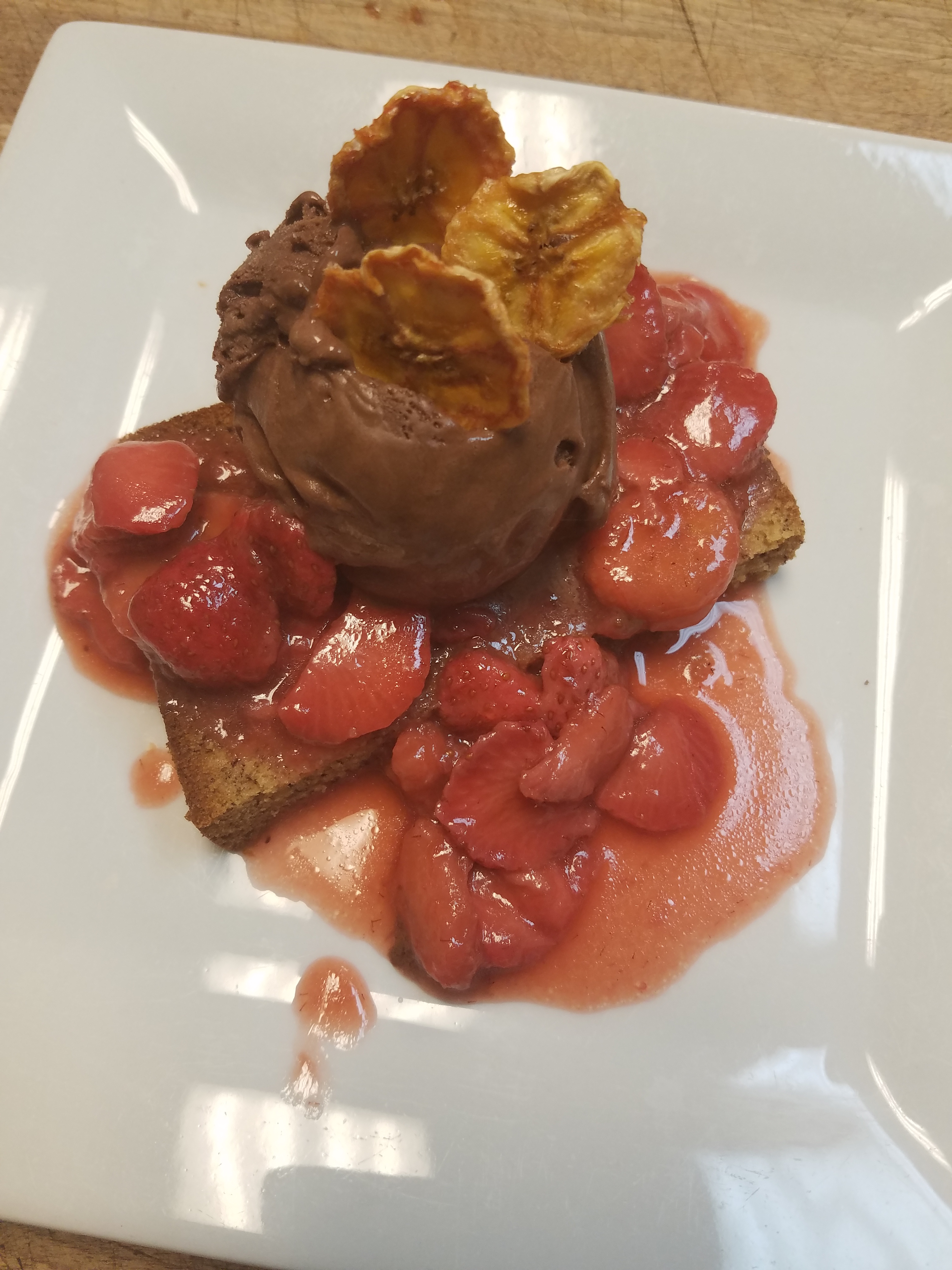
A simple strawberry-banana compote is a great accompaniment; garnish with chocolate gelato and banana chips.

Strawberry-Banana Compote

2 ripe bananas, peeled and sliced into 1/2″ slices

1 pint strawberries, cleaned, hulled and sliced

3 T unsalted butter

2 T light brown sugar

1 T lemon juice

1/4 C bourbon

Melt butter in a saucepan over medium heat. Reduce heat to low; add bananas,  strawberries and brown sugar. Cook until sugar has fully dissolved. Add bourbon; continue to simmer until the alcohol has cooked off, 7-10 minutes. Stir in lemon juice.


How Breadcrumbs (and Milk or Broth) Will Feed the World

An explosive web of silence, thrusts of gluten birth an ancient and savoury cadence…

Isn’t it an interesting evolution to realize that baked bread can sustain people even if they have nothing else to eat, while raw flour cannot?

Bread in its most basic form is often composed of nothing more than flour, water and salt. Bread can be combined with other very simple ingredients of nutritional value to form a basic diet that sustains us.

I am deeply inspired by Italian chef, Massimo Bottura, whose Osteria Francescana restaurant in Modena, Italy was named the top restaurant in the world earlier this summer by World’s 50 Best. Bottura has founded a non-profit organization, Food for Soul, that is partnering with Gastromotiva, founded by chef David Hertz,  to promote social change through gastronomy.

Refettorio Ambrosiano, Hertz’ community kitchen in Rio de Janeiro, will open its doors on 9-Aug to offer free meals to Rio residents who need food services. It will be open for dinner every day and Bottura and more than 30 guest chefs will cook with whatever surplus ingredients are available from the Olympic Village, local catering services and sponsors.

There are additional components to the future success of Bottura’s plan to open soup kitchens in other major cities around the world, including creating recipes with leftover bread, leveraging food waste and creating a sustainable food culture. It’s a much broader mission than just one event.

Lara Gilmore, Bottura’s wife says: “Massimo is very interested in creating recipes with leftover bread, so perhaps a pasta such as passatelli made with breadcrumbs in a broth of ‘everything’ or a dessert inspired by ‘Bread of Gold’, a recipe we serve at Osteria Francescana based on a milk and breadcrumb dessert from Massimo’s childhood.”

I often say that bread is my favorite food group. I love the easy juxtaposition of crunchy crust and crumb. A focaccia of humble beginning is easily elevated to art through the addition of fresh, inexpensive ingredients such as heirloom tomatoes, fresh garlic, onion, basil, fresh herbs and a bit, yes, a bit, of Parmigiano Reggiano. Oh yes, a few gobs of glorious olive oil. Accompany as you wish: roasted fresh vegetables, pickled and grilled local fruit or, oh well, a berry dessert.

Roasted heirloom tomato, onion, garlic and herb focaccia

Roasted heirloom tomato, onion, garlic and herb focaccia

Bread’s simple complexity has the power to sustain the world. As projects of this type and scope succeed and we, as a society, find ways to successfully redistribute food resources, we can, indeed, feed the world.

As a pastry chef, that’s a process I plan to actively support.

Riding the Tide of the Season

A green brush stroke at its base the last remnant of the life force that thrust into being its violaceous stalk, each tip pricked a muted gold…

The idea of local-seasonal food choices as a component of food ethics has been under my skin since it was first discussed in a food ethics class at the Oregon Culinary Institute.

Now that the seasonal tide has turned in favor of the freshest, most beautiful and most flavorful produce, the choices become easier.

Hoods!

Hoods!

Each week for the past month I’ve bought flats of tiny, early berries for strawberry-rhubarb compote, fresh strawberry sauce for strawberry-Moscato torte and as garnish for strawberry

Baba au Rhum

Baba au Rhum

shortcake and Baba au Rhum.

If I back this season up up by 45-60 days, my fruit choices are limited to Central Valley California, Mexico and Chile, a completely different depth of flavor and tenderness, and a whole lot of food miles.

I look at the issue professionally and personally. While baking and pastry is my profession, the Nicoletta’s Table pastry department also IMAG1059bakes daily savory tarts for the customer. Easy access to out-of-season zucchini, IMAG1054asparagus and onions, although convenient, does not equate to the baby zucchini, lithe IMAG1055asparagus and spring onions (particularly cipollini) currently in the market.


To me, choosing fruit and vegetables in season means not choosing them when they’re out of season.

Asparagus-Chevre Tart

Asparagus-Chevre Tart

If I’ve made a personal commitment to eat seasonally, I then must extend that commitment to my profession.

Let the sweetness of the season begin…


Autumnal Pastry Wedding

Fleeting ripeness portends kisses of chewy, jammy wine… 

A year, a seeming heartbeat, has passed since Oregon’s plum and grape bounty first revealed its intensely sweet succulence to me.

Now, with a Baking & Pastry Management degree from the Oregon Culinary Institute in my back pocket and as pastry chef at Nicoletta’s Table in Lake Oswego, I’m interested in ways the local bounty can be translated into fall desserts.

Enter Spiced Plum and Grape Tart. I felt the puritanical feature of IMAG0277my personality that surfaces as a love of intensely singular flavors falling away as I considered how best to enhance plums and grapes. The barest pinch of cloves, a few grindings of nutmeg, orange zest and a blush of cardamom. Vanilla bean-seeded sugar… just enough to support the flavor profile.

The Santa Rosa plum, Damson, the culinary plum, and Jupiter IMAG0279seedless Muscat grapes with a mildly tart skin. Amazing natural sweetness and depth of flavor.

As a new pastry chef, learning the keys to successful pastry feel linear and are, hopefully, cumulative. Use ingredients of similar temperature. Aerate the butter for crustier tart dough. Don’t overwork the dough after the flour is added.  

IMAG0286

The finished tart, teased quickly to room temperature in the blast chiller. Thin, tender, flavorful crust juxtaposed wit the rich, married flavors of plums and grapes. Cream whipped to soft peaks adorned with gems of candied orange.

A happy marriage, indeed.


There’s an Endorphin in that Cloud of Meringue

Inner foliage, the jeweled fruit of panettone, a sup of bourbon and Marsala…

St Helens floats on the skyline with the look of a cake whose meringue has slipped off into billowy piles around its base. Hummingbirds dot the inner distance – playful-aggressive specks on the outer magnificence.

Sliding meringue. A disparaging experience, eliciting feelings of helplessness and disbelief, par for the course for a new pastry chef, I suppose. There’s no shoring it up when it has insufficient structure. Had forgotten to use a hard meringue (with a larger ratio of sugar to egg whites) to frost the Salted Caramel Chocolate Torte.  The oversight was a Baking 101 moment.

I used a soft meringue, of course, as the foundation for the Italian buttercream flavored with salted caramel sauce that graces the three chocolate layers. Fluffy, elegant, a thing of beauty.

salted caramel torteCarbon-torched peaks and edges, a wickedly fun finishing technique. Drizzles and puddles of salted caramel sauce and crushed toasted hazelnuts tossed with abandon on the snow-capped torte.

Dessert creation isn’t about perfection, although that quality is certainly inherent in a pastry chef’s personality. It’s not about speed, but speed arises naturally through rote… developing a feel for the product, its behavior, its viability. But, hit the sweet spot of knowledge and technique, and an endorphin kicks in that can only be likened to that delicious reaction to a beautiful landscape.

Even if the clouds have slid off the mountain.

Page 9 of 14

Powered by WordPress & Theme by Anders Norén